
CCTV Camera
Table of Contents
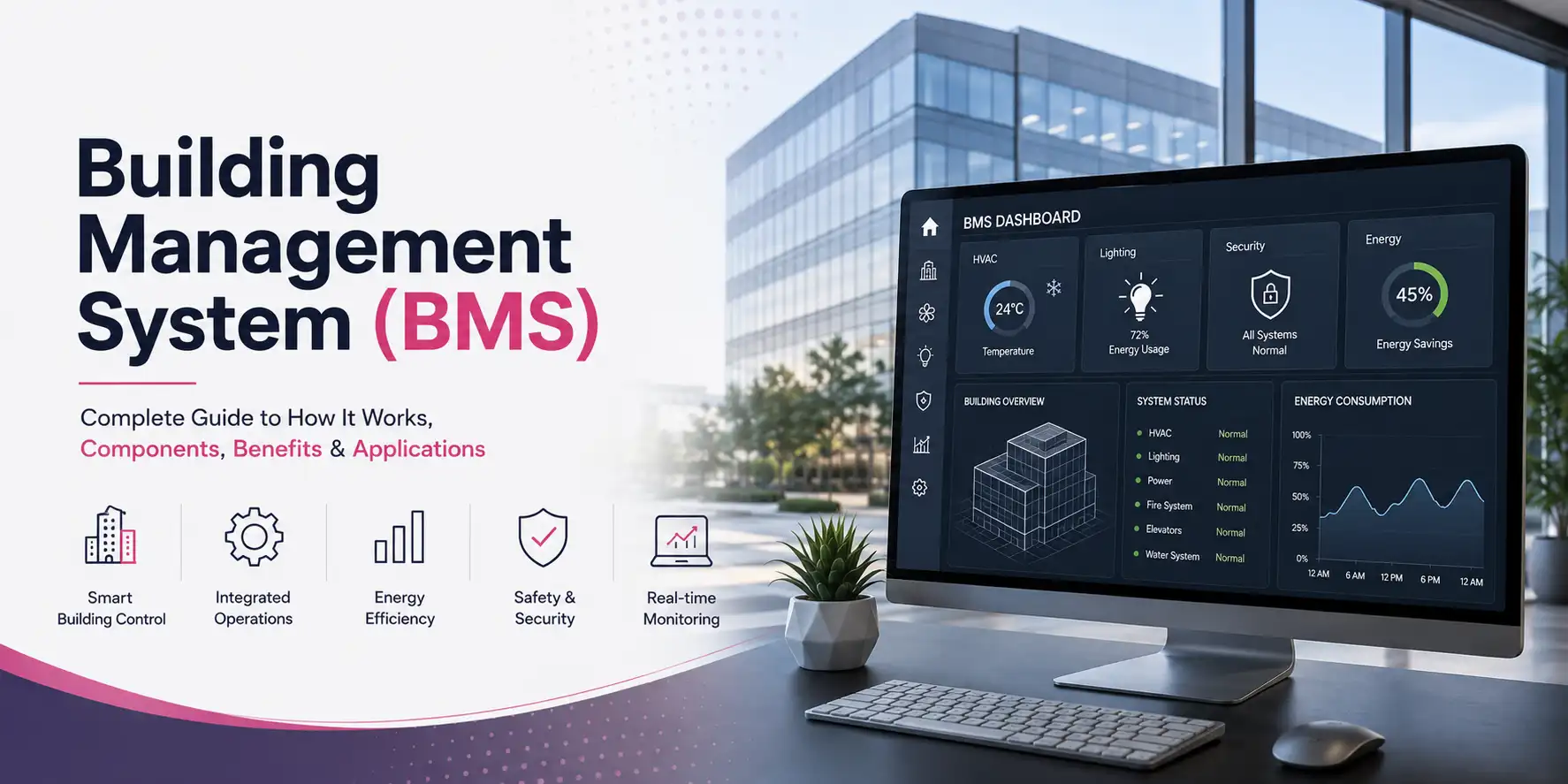
A modern building is more than walls, lighting, and air conditioning. Commercial facilities, hospitals, industrial plants, data centres, and corporate campuses depend on multiple systems working continuously: HVAC, lighting, electrical equipment, energy monitoring, fire safety, and security. The challenge is managing all these systems efficiently. A Building Management System (BMS) provides a centralized way to monitor and manage many of these building functions. Instead of relying on separate systems and manual checks, facility teams can use BMS technology to collect information, identify operating conditions, receive alerts, and automate selected building functions.
But what exactly is a BMS? How does it work? What components does it require? And what should businesses and system integrators consider when selecting BMS hardware?
This complete guide explains the fundamentals of a Building Management System, its components, applications, benefits, integration possibilities, and important considerations when planning a building automation project.
What Is a Building Management System?
A Building Management System (BMS) is a centralized platform used to monitor and control selected mechanical, electrical, and building services.
Depending on the building and system architecture, a BMS can bring information from systems such as:
- HVAC
- Temperature and humidity sensors
- Lighting systems
- Energy meters
- Electrical infrastructure
- Fire alarm systems
- Access control systems
- CCTV and security systems
- Other building equipment
The purpose is not simply to put everything on one screen. A properly designed BMS helps facility teams understand what is happening throughout a building and respond more efficiently.
For example, if a temperature sensor detects that an area is warmer than the desired operating range, the BMS can display that information and, depending on the system design, initiate an appropriate control action through connected equipment.
This makes BMS an important part of modern building automation and facility management.
How Does a Building Management System Work?
A BMS generally works through several layers of hardware, communication, and software.
A simple way to understand the process is:
Sensors → Controllers → Communication Network → BMS Software → Monitoring & Control
1. Sensors collect information
Sensors installed throughout a building measure conditions such as:
- Temperature
- Humidity
- Air quality
- Occupancy
- Pressure
- Energy consumption
- Other environmental or equipment parameters
For example, a temperature sensor in an office area can continuously provide information about the room environment.
2. Controllers process information
BMS controllers receive information from field devices and sensors.
The controller can evaluate the information according to the programmed requirements and communicate with connected equipment.
Controllers therefore act as an important link between field devices and the centralized BMS platform.
3. Communication connects different systems
Building automation requires reliable communication between devices.
Depending on the project architecture, different communication technologies and protocols may be used to connect controllers, meters, sensors, equipment, and software.
Compatibility should therefore be considered early in a BMS project.
4. Software provides centralized monitoring
BMS software provides operators with a centralized interface where they can monitor system conditions, view data, identify alarms, and analyze building performance.
Instead of physically checking every area, facility personnel can use the monitoring platform to understand the status of connected systems.
5. Control actions can be automated
Where the system has been designed for control, BMS can use programmed conditions to initiate actions.
For example, HVAC operation may be adjusted according to temperature, schedules or other defined conditions.
The exact level of automation depends on the equipment, controllers, programming and overall project design.
What Does a BMS Control?
One of the most common questions about Building Management Systems is what they can actually manage.
The answer depends on the building’s equipment, integration architecture and project requirements.
Common areas include:
HVAC Management
HVAC is one of the most important applications of BMS.
A BMS can provide visibility into aspects such as:
- Temperature
- HVAC equipment status
- Operating schedules
- Air-handling equipment
- Cooling and heating conditions
- Environmental sensors
This can help facility teams identify abnormal conditions and operate HVAC systems more effectively.
Lighting Management
Building automation can also be used to monitor and manage lighting systems where suitable control infrastructure is available.
Lighting schedules, occupancy information and other predefined conditions can be used as part of an automation strategy.
Energy Monitoring
Energy monitoring allows facility teams to understand where electricity is being consumed.
Meters and monitoring devices can provide information about energy usage across different areas or systems.
This data can help identify unusual consumption patterns and support better operational decisions.
Fire Alarm Integration
A BMS can be designed to receive information from compatible fire alarm systems.
However, BMS integration should not be confused with replacing a dedicated fire alarm system.
Fire detection and life-safety functions remain dependent on the appropriate dedicated systems, design and applicable requirements.
Access Control and Security Integration
Depending on the architecture and compatibility of the systems involved, BMS platforms may integrate with access control, CCTV and other security infrastructure.
This can provide operators with a more unified view of building conditions.
Key Components of a Building Management System
A BMS is not one single device. It is an ecosystem of hardware, software, sensors, communication infrastructure and connected building equipment.
1. BMS Controllers
Controllers are among the most important components of a BMS.
They communicate with field devices, process information, and execute programmed control logic.
When selecting controllers, system integrators should consider:
- Number of inputs and outputs
- Required control functions
- Communication protocols
- Network architecture
- Scalability
- Compatibility with other equipment
- Future expansion requirements
Choosing a controller simply based on price can create limitations later in the project.
2. Environmental Sensors
Sensors provide the data required for monitoring and automation.
Depending on the application, these may monitor:
- Temperature
- Humidity
- Air quality
- Occupancy
- Pressure
- Other environmental conditions
Sensor quality matters because inaccurate information can affect the decisions made by the automation system.
3. Energy Monitoring Devices
Energy monitoring components help measure electrical consumption.
They can provide useful information for:
- Energy analysis
- Load monitoring
- Equipment performance assessment
- Identifying unusual consumption
- Facility management
For larger buildings, having visibility into energy consumption can be particularly valuable.
4. Communication and Integration Hardware
BMS projects often involve equipment from different systems.
Communication and integration hardware helps these systems exchange information where compatible interfaces and protocols are available.
This is one reason system architecture should be considered before selecting individual components.
5. Central Monitoring Software
The software layer gives facility operators a centralized interface.
Depending on the system, operators may be able to:
- View equipment status
- Monitor environmental conditions
- Review energy information
- Receive alerts
- Analyze trends
- Manage schedules
- View historical data
A well-designed interface makes complex building information easier to understand.
BMS Component Overview
| BMS Component | Main Function | Example Application |
| Controllers | Process inputs and execute control logic | HVAC automation |
| Temperature Sensors | Monitor temperature | Offices, hospitals, data centres |
| Humidity Sensors | Monitor humidity | Controlled environments |
| Air Quality Sensors | Monitor environmental conditions | Commercial buildings |
| Energy Meters | Measure electrical consumption | Energy monitoring |
| Integration Hardware | Connect compatible systems | Multi-system BMS |
| Monitoring Software | Centralized monitoring and management | Facility control room |
What Are the Benefits of a Building Management System?
A properly planned BMS can provide several operational benefits.
Centralized Monitoring
Instead of depending entirely on manual inspection, facility teams can view information from connected building systems through a centralized platform.
This can improve visibility across large facilities.
Better Operational Awareness
Real-time information helps facility personnel understand equipment conditions and identify problems more quickly.
For example, an abnormal temperature reading may indicate a problem that requires investigation.
Energy Management
BMS can provide data that helps businesses understand energy consumption.
By monitoring HVAC, electrical systems, and other energy-consuming equipment, facility teams can identify opportunities for improved operation.
A BMS does not automatically guarantee a specific percentage of energy savings. Actual results depend on building design, equipment, controls, operating practices, and how effectively the system is managed.
Improved HVAC Management
HVAC systems can be complex and energy-intensive.
BMS can provide centralized visibility and, where appropriate, automated control based on schedules, environmental conditions and programmed logic.
Faster Fault Identification
Alerts and monitoring can help operators identify abnormal conditions earlier.
Instead of discovering a problem only after occupants complain or equipment stops working, facility personnel may be able to detect an unusual condition through system monitoring.
Improved Facility Management
A centralized BMS can reduce the complexity of managing multiple building systems.
Facility teams can use information from the system to make more informed operational decisions.
Scalability
Modern BMS platforms can be designed to expand as building requirements grow.
This is especially useful for:
- Large commercial facilities
- Corporate campuses
- Industrial facilities
- Data centres
- Multi-building environments
Scalability should be considered during the initial system design rather than added as an afterthought.
BMS and Energy Efficiency: How Are They Connected?
Energy efficiency is one of the major reasons businesses consider building automation.
Consider a commercial building operating HVAC equipment throughout the day.
Without adequate monitoring, facility personnel may not have clear visibility into:
- Which equipment is consuming energy
- When consumption increases
- Whether equipment is operating outside expected schedules
- Which areas are experiencing unusual conditions
A BMS can bring information from sensors, meters, and connected equipment into a centralized environment.
This gives facility teams data they can use to investigate consumption patterns and improve operating practices.
For example:
Temperature sensor → Controller → HVAC equipment → BMS monitoring → Facility team
The system can help connect environmental conditions with equipment operation and energy information.
The important point is that BMS is a tool for visibility, control, and informed decision-making. Energy savings depend on how the building, equipment, and automation strategy are designed and operated.
BMS Applications by Industry
| Industry | Typical BMS Application | Potential Operational Benefit |
| Commercial Buildings | HVAC, lighting, and energy monitoring | Centralized facility management |
| Hospitals | Environmental and HVAC monitoring | Better visibility of building conditions |
| Industrial Facilities | Infrastructure and energy monitoring | Operational awareness |
| Data Centres | Temperature and power monitoring | Monitoring of critical conditions |
| Corporate Campuses | Multi-building automation | Centralized management |
BMS Integration With Other Building Systems
A modern building rarely operates as a collection of completely independent systems.
A BMS may integrate with compatible systems such as:
HVAC
HVAC is often at the heart of building automation.
BMS can provide monitoring and, where supported by the system architecture, control of HVAC equipment.
Fire Alarm Systems
Compatible fire alarm systems can provide information to a BMS platform for centralized monitoring.
However, the BMS should not be considered a replacement for a dedicated fire alarm system.
Access Control
Access control integration can allow relevant access events or system information to be available within a broader building-management environment.
CCTV and Security
Security infrastructure may also be integrated into a broader building-management architecture when the relevant systems support the required communication and integration.
Energy Monitoring
Energy meters and monitoring devices can provide valuable data for facility management and energy analysis.
The most important consideration is compatibility.
Before purchasing BMS hardware, system integrators should determine which equipment, protocols and interfaces are required for the project.
Why Does the BMS Distributor Matter?
For system integrators and dealers, the quality of the supply chain can have a direct impact on project execution.
A BMS project may require multiple types of components, including controllers, sensors, monitoring modules, and integration hardware.
Working with an experienced distributor can simplify procurement and help integrators source the required equipment through an established B2B distribution network.
When evaluating a BMS distributor, consider:
- Product range
- Hardware availability
- Brand ecosystem
- Product authenticity
- Technical product knowledge
- Distribution capability
- Communication
- Support for system integrators
- Ability to source components for project requirements
The distributor should be viewed as part of the project’s supply chain, not simply as a place to purchase individual products.
BMS System Supplier in Ahmedabad: What Should You Look For?
If you are searching for a BMS supplier in Ahmedabad, price should not be the only deciding factor.
For system integrators, dealers, and project professionals, it is useful to evaluate the supplier based on:
- Product availability
- Range of BMS components
- Compatibility across the project
- Brand relationships
- Distribution capability
- Technical understanding
- Procurement support
- Reliability of supply
- Ability to support future requirements
ADI Solutions operates from Ahmedabad and supports dealers and system integrators with BMS and building automation hardware through its distribution network. The company’s BMS page identifies Ahmedabad, Jaipur, Lucknow, and Mumbai as its supply locations and lists components such as controllers, sensors, monitoring modules, and integration hardware.
Final Thoughts: Why BMS Matters for Modern Buildings
A Building Management System is ultimately about better visibility, smarter control and more informed facility management.
As buildings become more complex, managing HVAC, energy, environmental conditions and other infrastructure independently can make operations more difficult.
BMS provides a way to bring compatible building systems into a centralized management environment.
However, successful BMS deployment starts long before software appears on a monitoring screen.
The right sensors, controllers, communication infrastructure, integration strategy and hardware supply chain all contribute to the effectiveness of the final system.
For system integrators and dealers, selecting the right BMS components and a dependable distribution partner is therefore an important part of project planning.
Looking for BMS Hardware for Your Next Project?
If you are a system integrator, BMS dealer, or building automation professional looking for controllers, sensors, monitoring modules or other BMS hardware, ADI Solutions supports B2B partners with building automation products through its distribution network.
ADI Solutions operates from Ahmedabad, Jaipur, Lucknow, and Mumbai and supports dealers and system integrators working on building management and automation projects.
Explore the Building Management System range:
https://adisolutions.co.in/building-management-system
For project-specific requirements, contact the ADI Solutions team to discuss the BMS hardware required for your application.
Frequently Asked Questions About Building Management Systems
What are the main components of BMS?
Typical components include BMS controllers, sensors, energy monitoring devices, communication/integration hardware, and centralized monitoring software.
Can BMS reduce energy consumption?
BMS can support energy-efficiency efforts by providing information about building conditions, equipment operation, and energy consumption. Actual savings depend on the building, equipment, controls, and operating strategy.
Is BMS the same as building automation?
The terms overlap significantly. BMS generally refers to centralized building monitoring and management, while building automation emphasizes automated control of building systems. The exact distinction varies between projects.
What systems can integrate with BMS?
Depending on compatibility and system architecture, BMS can integrate with HVAC, lighting, energy monitoring, fire alarm, access control, CCTV, and other building infrastructure.
Where are BMS systems commonly used?
BMS is commonly used in commercial buildings, hospitals, industrial facilities, data centres, and corporate campuses.
Are BMS systems scalable?
Many modern BMS architectures are designed to scale across larger buildings and multi-building environments. Scalability should be considered during system design.
What should I consider when selecting BMS hardware?
Consider compatibility, communication protocols, controller capacity, sensor requirements, scalability, product availability, integration requirements, and long-term maintenance.
What is the role of a BMS distributor?
A BMS distributor supplies the hardware and components required by dealers and system integrators for BMS projects. A distributor can form an important part of the project’s procurement and supply chain.
Does ADI Solutions install BMS systems?
According to its current BMS page, ADI Solutions operates as a BMS distributor/supplier and supplies hardware used in BMS projects. System design can be done by ADI Solutions, and we can provide Telephonic/remote support.