
Fire Alarm System
Table of Contents
Quick answer: Effective rodent control system for server rooms combines physical sealing of every cable entry and gap with an ultrasonic rodent repeller system. The system’s transducers are placed below the raised floor, above the false ceiling and along cable trays. Poison baits are a poor fit inside server rooms, because rodents can die in floor voids next to live equipment.
A network switch goes down at 3 a.m. The NOC team checks the config, swaps the SFP and reboots the device. Nothing works. Two hours later, someone lifts a floor tile and finds the fibre patch cord chewed through, with droppings all around it.
This is more common than most IT and facility teams expect. Server rooms are warm, quiet, rarely visited at night and full of exactly what rats like to chew. This guide explains why rodents target server rooms, why the usual pest control methods don’t suit them, and how to plan rodent control system using ultrasonic repeller systems.
Why Rats Target Server Rooms
Warmth. Servers, UPS systems and switches produce constant heat. In winter or during the monsoon, a server room is one of the most comfortable places in a building for a rat.
Hidden pathways. Raised floors, false ceilings and cable trays create a connected network of dark, undisturbed spaces. Rats can move across an entire floor without ever being seen.
Constant need to gnaw. A rat’s front teeth never stop growing, so it has to gnaw constantly to keep them in check. PVC cable insulation and fibre jackets are soft, easy to chew and everywhere in a server room.
Easy entry. Every cable penetration through a wall or slab is a potential entry point. If it wasn’t sealed properly after the last cabling job, rats will find it.
What Rodent Damage Actually Costs
The direct repair, a new patch cord or a re-terminated cable, is usually cheap. Everything around it isn’t:
- Downtime. Intermittent faults from partially chewed cables are hard to trace. Teams can spend hours troubleshooting hardware before anyone thinks of rodents.
- Fire risk. Chewed power cables expose live conductors. In a room packed with equipment and cabling, that’s a genuine fire hazard. This is one reason server rooms usually also need fire detection and gas-based suppression systems.
- Hygiene risks. Droppings and urine under the raised floor spread bacteria and get pulled into the cooling airflow.
- Operational and compliance exposure. For banks, hospitals and data centres, an outage caused by rodents is still an outage, with the same audit and SLA consequences.
Why Traditional Pest Control Doesn’t Fit Server Rooms
| Method | Problem in a Server Room |
| Poison baits | Rats often die inside raised floors, false ceilings or behind racks. The decomposing carcass causes odour, flies and contamination, and finding it means lifting tiles near live equipment |
| Glue traps and snap traps | Need checking every day. Most server rooms have restricted access, so traps go unchecked for days |
| Chemical sprays and fumigation | Residue near sensitive electronics, and the room often can’t be vacated for treatment |
| Periodic pest control visits | Monthly or quarterly visits leave long gaps in protection between visits |
What a server room needs is protection that works 24 hours a day, without chemicals, carcasses or daily manual checks. That’s where ultrasonic rodent repellers fit.
How Ultrasonic Rodent Repeller Systems Work
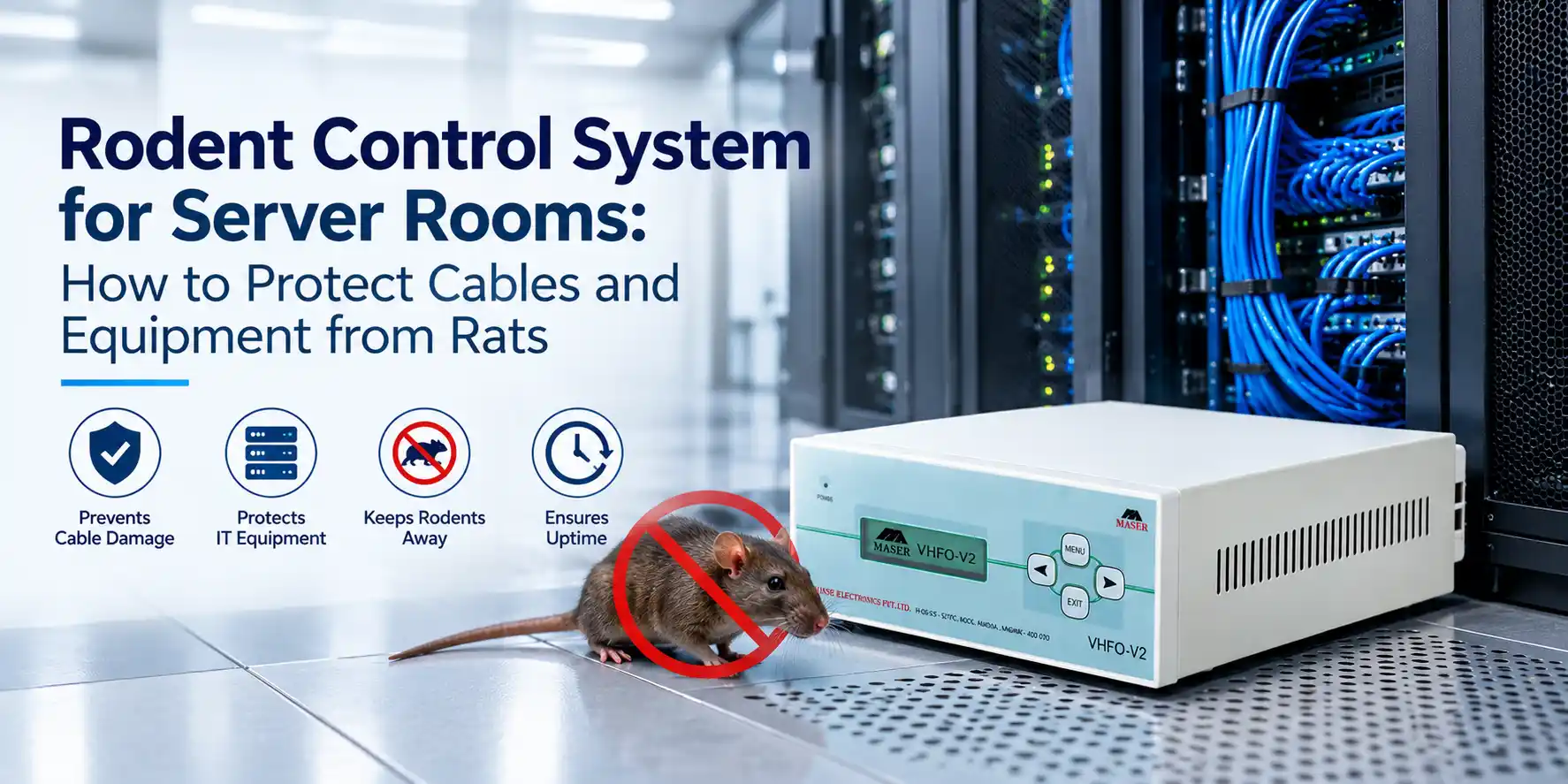
Ultrasonic rodent repellers are the most widely used rodent control technology for server rooms, electrical rooms and other critical spaces in India. A professional system has two main parts:
A central controller: It is mounted on a wall and powers and drives the transducers.
Ultrasonic transducers (speakers): These are installed in the spaces you want to protect. They emit high-frequency sound above the range of human hearing, which rodents find extremely disturbing.
The system runs continuously, and good systems keep changing the frequency so rodents don’t get used to a single tone. The aim is to make the protected space so uncomfortable that rodents avoid it and stay away.
Two points matter for setting the right expectations:
It repels, it doesn’t detect: An ultrasonic repeller does not detect rats, count them or confirm that they have left. It simply keeps the protected space hostile to rodents, around the clock.
Ultrasound behaves like light, not like Wi-Fi: It doesn’t pass through walls, floor tiles or solid objects, and dense cable bundles block it. Each enclosed space needs its own transducers, with a clear line of sight across that space.
The Three Zones You Must Cover
Most server room installations fail because only one zone is protected. Rats simply move to the zone that isn’t.
1. Below the raised floor
This is the most important zone. It carries the most cabling, it’s dark and undisturbed, and rats move through it freely. Place transducers so the sound covers the full void, keeping in mind that cable bundles, pedestals and ducts create “shadows” the sound can’t reach.
2. Above the false ceiling
Rats often enter through the ceiling void from neighbouring areas and travel along overhead cable trays. Transducers here cover the trays and the gaps where walls don’t reach the slab.
3. Room level and cable trays
Transducers at room level cover rack tops, overhead ladder trays and the space behind racks, especially near cable entry points.
The number of transducers depends on the room’s size, the height of each void, how dense the cabling is and the coverage rating of the specific model. Always size from the manufacturer’s datasheet, and add extra transducers where large cable bundles or ducts block the sound.
What Ultrasonic Repellers Can and Can’t Do
Setting the right expectations matters, because overselling leads to disappointed clients.
Ultrasonic repellers work best in enclosed spaces like server rooms, false ceilings and raised floors, where the sound stays contained. Professional systems that vary their frequency perform far better than cheap plug-in devices that emit a single tone. But no repeller can stop rodents that keep coming in through open holes. Ultrasound makes the space hostile, and sealing removes the way in. You need both.
A Layered Rodent Control System Plan for Server Rooms
Step 1: Seal every entry point: Close all cable penetrations through walls and slabs with fire-rated sealant, and use rodent-proof mesh where needed. Check door bottoms, gaps around AC piping and openings above the false ceiling. Re-check after every cabling job, since installers often leave holes open.
Step 2: Install an ultrasonic rodent repeller system: covering all three zones: under the floor, above the ceiling and at room level.
Step 3: Protect the most critical cables: For high-risk routes, such as backbone fibre or cables entering from outside the building, consider armoured or rodent-protected cable, or run cables in closed conduit.
Step 4: Check the system regularly: Confirm during routine maintenance that the controller and every transducer are powered and working. Many server rooms also have water leak detection under the raised floor, and a building management system can bring the room’s safety systems onto one dashboard.
Step 5: Keep it clean: No food or drinks in the server room, no stored cardboard boxes under the floor, and a regular under-floor inspection during maintenance visits.
5 Common Mistakes
Using plug-in home repellers
A cheap plug-in device covers a small open area at best. It can’t reach under the raised floor or above the ceiling, where rats actually are.
Covering only the room
If transducers are only at room level, rats stay comfortably under the floor.
Ignoring cable shadows
A transducer behind a thick cable bundle protects almost nothing beyond it.
Skipping the sealing
Without sealing, rodents keep entering, and the repeller has to fight a constant stream of new arrivals.
No maintenance check
A transducer that failed six months ago looks exactly like one that’s working. Include the system in routine facility maintenance.
Beyond Server Rooms: Other Areas That Need Rodent Control
Server rooms are only one of many places where ultrasonic rodent repellers protect property and operations. The same systems are widely used in:
- Electrical panel rooms, where chewed wiring can cause short circuits, tripping and fire risk
- Food storage and processing units, where contamination can lead to product loss and failed hygiene audits
- Grocery shops and supermarkets, where rodents damage stock and affect customer trust
- Paper and packaging industries, where rodents damage raw material and finished goods
- Warehouses and logistics centres, where large storage areas let infestations spread quickly
- Hospitals and commercial buildings, where hygiene and uninterrupted operations are critical
Planning Rodent Control System for a Server Room?
ADI Solutions distributes professional ultrasonic rodent repeller systems from leading OEMs, including Maser, Synopsys and C Systems, to system integrators, dealers and facility teams across Gujarat, Maharashtra and Rajasthan. Share your server room layout, area and void heights, and our team will help you plan transducer quantities and placement.
Explore our rodent control systems or get a project quote →
Frequently Asked Questions
What is the best rodent control for server rooms?
A combination of sealing all entry points and an ultrasonic rodent repeller system covering the raised floor, false ceiling and cable trays. Avoid poison baits inside the room, as rodents may die in inaccessible voids.
Is an ultrasonic rodent repeller safe for servers and people?
Yes. Ultrasonic sound doesn’t affect electronic equipment, and the frequencies used are above the range of human hearing. Some pets, especially rodent pets like hamsters and rabbits, can be affected, but this is rarely a concern in a server room.
Does an ultrasonic repeller detect or count rats?
No. An ultrasonic repeller doesn’t detect rats, count them or confirm they have left. It works by continuously making the protected space uncomfortable for rodents so they stay away.
Do rats get used to ultrasonic repellers?
They can get used to a single fixed frequency, which is why cheap devices often stop working. Professional systems vary the frequency to reduce this. Sealing entry points is still essential.
How many transducers does a server room need?
It depends on the room’s area, the number of voids (under the floor, above the ceiling, room level), cable density and the coverage rating of the model. Most server rooms need transducers in each void, not just one unit in the room.