
CCTV Camera
Table of Contents
Conference room AV solutions combine displays, audio equipment, video conferencing hardware, and a control system into one manageable setup. A good conference room build starts with a room assessment, matches display and audio hardware to the room size, adds a control system that scales across multiple rooms, and is sourced from a supplier that offers reliable stock, support, and warranty coverage.
ADI Solutions supplies these components (displays, audio, AV control systems) to dealers and system integrators from its offices in Ahmedabad, Mumbai (Thane), and Jaipur.
This guide breaks down what to evaluate before you spec a conference room AV system, from room size and display type to control systems and vendor selection, so you can make sourcing decisions with confidence.
What Are Conference Room AV Solutions?
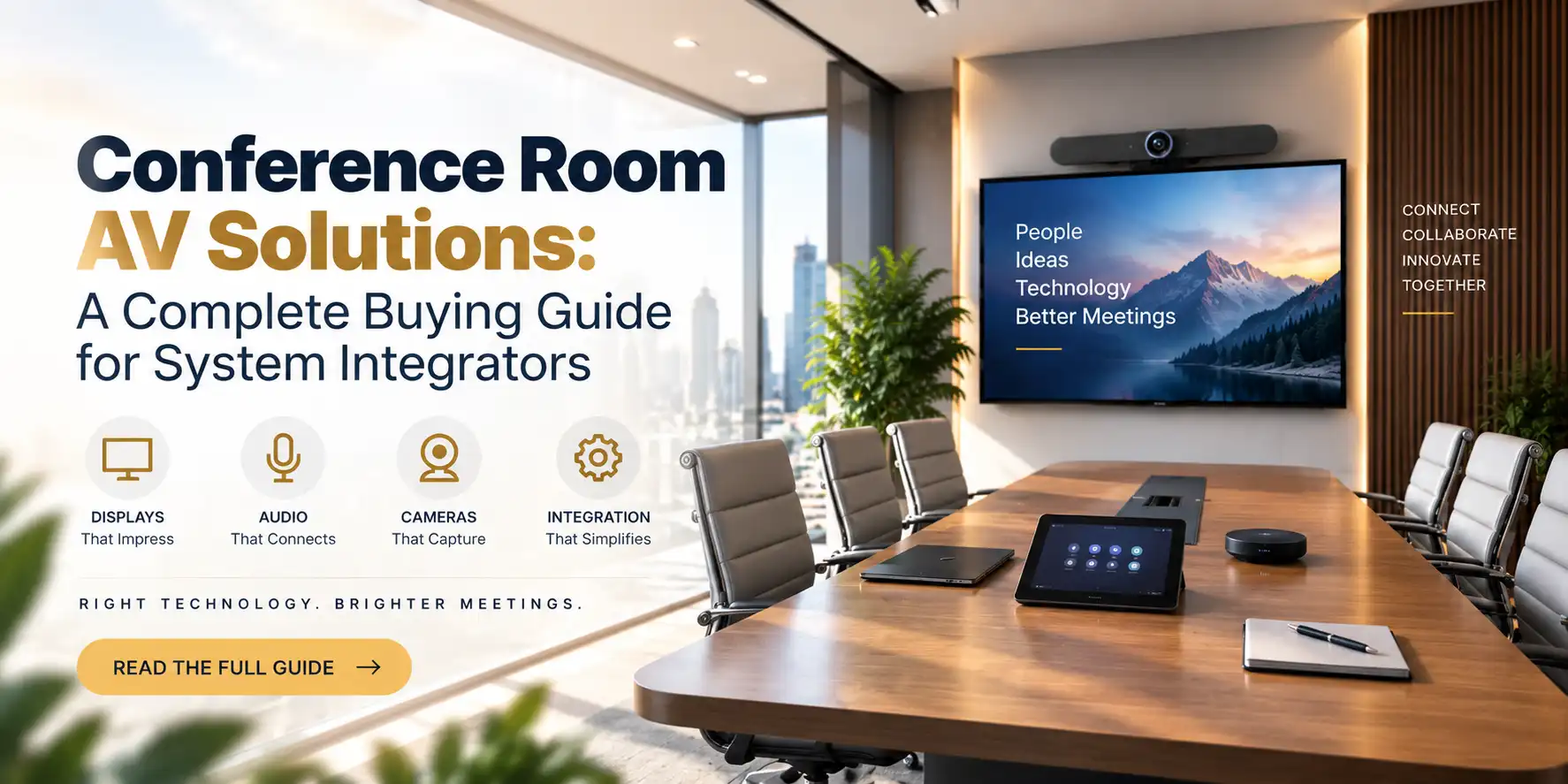
Conference room AV solutions are integrated systems of audio, video, and control equipment designed to support meetings, presentations, and video conferencing in a shared space. A typical setup includes:
- Display technology: LED displays, interactive panels, or projectors for showing content
- Audio equipment: microphones, speakers, amplifiers, and mixers for clear sound
- Video conferencing hardware: cameras, soundbars, and codecs for remote collaboration
- AV control systems: centralized panels or software that manage all connected devices from one interface
The goal is a room where a user can walk in, tap one button, and start a meeting without needing to understand what is happening behind the scenes.
Step 1: Start With the Room, Not the Product Catalog
The most common mistake integrators make is selecting components before understanding the space. Before recommending any hardware, assess:
- Room size and shape: a huddle room for 4 people has very different needs than a boardroom for 20
- Ambient lighting determines whether a projector or a bright LED display is the better fit
- Acoustic conditions: hard surfaces and glass walls need more microphone coverage and acoustic treatment
- Network infrastructure: AV-over-IP and video conferencing systems depend on adequate bandwidth and VLAN segmentation
- Usage pattern: Is the room primarily for internal presentations, client meetings, hybrid video calls, or training?
A room assessment checklist at the start of every project prevents costly rework later.
Step 2: Choosing the Right Display
| Display Type | Best For | Key Consideration |
| Interactive flat panel | Small to mid-size rooms, collaborative meetings | Touch functionality, built-in annotation software |
| LED video wall | Large boardrooms, auditoriums, lobbies | Higher upfront cost, no ambient light issues |
| Laser projector | Large rooms, training halls, budget-conscious projects | Needs controlled lighting for clarity |
For most standard conference rooms, integrators are shifting toward interactive flat panels because they combine display and whiteboarding functionality without needing a separate projector screen.
Step 3: Getting Audio Right
Audio is where many conference room deployments fail, even when the visuals look great. Poor audio directly affects meeting quality more than poor video.
Key components to spec:
- Ceiling or table microphones, ceiling arrays work best for larger rooms with fixed seating; table mics suit smaller, flexible spaces
- DSP (Digital Signal Processing) units handle echo cancellation and audio mixing automatically
- Speakers and amplifiers should be sized to the room volume, not just the budget
- Soundbars an increasingly popular all-in-one option for small to mid-size huddle rooms
Rule of thumb: for any room with 8 or more participants, or a table longer than 3 metres, avoid relying on a single built-in laptop or camera microphone.
Step 4: AV Control Systems Tie Everything Together
An AV control system lets a user manage the entire room, including display, audio, lighting, blinds, and video conferencing, from a single touch panel or app, instead of juggling multiple remotes and settings menus.
For integrators, this is also where recurring revenue often lives, since control systems typically require configuration, programming, and ongoing support.
What to evaluate in a control system:
- Ease of programming: How much custom coding is required versus pre-built templates
- Scalability: Can the same platform manage a single room or an entire campus of rooms
- Third-party integration: Compatibility with video conferencing platforms such as Teams, Zoom, and Google Meet, plus lighting and building management systems
- Remote monitoring: Cloud-based dashboards that let integrators diagnose issues without an on-site visit
- Vendor ecosystem: Established platforms like Crestron and Extron offer wider hardware compatibility and long-term support
A well-specified control system reduces support calls and keeps multi-room deployments consistent, which matters when a client is standardizing AV across offices, campuses, or training centers.
Step 5: Video Conferencing Integration
With hybrid work now standard, almost every conference room build includes video conferencing capability. When sourcing components, prioritize:
- Cameras with auto-framing or speaker-tracking for larger rooms
- Certified compatibility with the client’s preferred platform, such as Microsoft Teams Rooms or Zoom Rooms
- One-touch join functionality integrated with the room’s control system
- Content sharing that works both wirelessly and via cable, since not all visitors will have the same devices
Step 6: Vendor and Supplier Selection
The reliability of a conference room AV deployment depends heavily on the supplier behind the components, not just the components themselves. When evaluating an AV solutions supplier, integrators should check for:
- Product availability and lead times: delays in a single component, like a DSP unit, can stall an entire installation
- Technical support: pre-sales design assistance and post-sales troubleshooting
- Warranty and after-sales service: especially important for control systems and display panels
- Range across categories: a supplier offering displays, audio, networking, and control systems under one roof simplifies procurement and reduces compatibility issues
- Local presence: faster replacement parts and on-ground support for time-sensitive projects
ADI Solutions works with dealers and system integrators across India, with a Head Office in Ahmedabad and branch offices in Thane (Mumbai) and Jaipur, supplying displays, audio components, networking gear, and AV control systems from a single source. This multi-city presence is one reason integrators in Gujarat, Maharashtra, and Rajasthan consolidate their AV sourcing through a single supplier rather than juggling multiple vendors for different regions.
Why System Integrators Choose ADI Solutions
Product Consultation
ADI Solutions helps dealers and system integrators understand project requirements and select the right combination of displays, audio, and control systems based on room size, budget, and end-client use case.
Technical Support
Integrators get assistance with product selection, compatibility checks, configuration guidance, and troubleshooting during and after the AV deployment.
Warranty and After-Sales Support
ADI Solutions assists with warranty coordination and RMA processes for AV components, reducing delays and downtime on live projects.
Complete Security and AV Portfolio
Alongside AV solutions and AV control systems, ADI Solutions supplies:
- CCTV and Video Surveillance
- Fire Alarm Systems
- Access Control and Gate Automation
- Intrusion Alarm and Home Security Solutions
- Building Management Systems (BMS)
- Active and Passive Networking
- Public Address and Conference Sound Systems
- Gas Detection and Suppression Systems
- EPABX and Emergency Intercom Systems
- Water Leak Detection Systems
- Rodent Control Systems
This lets integrators source AV, networking, and security components for a project from one supplier instead of coordinating across multiple vendors.
Common Mistakes to Avoid
- Under-speccing audio while over-investing in displays
- Ignoring network readiness for AV-over-IP and video conferencing traffic
- Choosing a control system without checking third-party integration with the client’s existing platforms
- Skipping acoustic treatment in rooms with glass walls or hard flooring
- Not planning for scalability when a client is likely to replicate the room design across multiple locations
Quick Buying Checklist for System Integrators
- Room assessment completed (size, lighting, acoustics, network)
- Display type matched to room size and lighting conditions
- Microphone coverage matched to room layout and seating capacity
- DSP and audio processing are included for echo and noise handling
- The control system supports the required scalability and third-party integrations
- Video conferencing hardware certified for the client’s preferred platform
- Supplier confirmed for lead times, warranty, and technical support
Frequently Asked Questions
What is included in a conference room AV solution?
A conference room AV solution typically includes a display (panel, video wall, or projector), audio equipment (microphones, speakers, DSP), video conferencing hardware (camera, codec), and a control system to manage all devices from one interface.
What is the difference between AV integration and an AV control system?
AV integration is the overall process of combining audio, video, and network components into a working system. An AV control system is one part of that integration: the centralized platform that lets users operate all connected devices from a single interface.
How do I choose between a projector and a flat panel display for a conference room?
Flat panel displays work best in rooms with variable ambient light and where interactivity, such as touch and annotation, is needed. Projectors remain a cost-effective option for larger rooms where lighting can be controlled.
Do small huddle rooms need a full AV control system?
Not always. Small rooms with 2 to 4 people can often run on a simplified, one-touch setup, while larger boardrooms and multi-room deployments benefit more from a full control system for consistency and remote management.
Why is audio more important than video in conference room AV setups?
Meeting participants tolerate minor video lag more easily than poor audio, since unclear audio directly disrupts communication and comprehension during a meeting.
Who supplies conference room AV solutions and AV control systems to system integrators in India?
ADI Solutions is an AV solutions and AV control systems supplier with its Head Office in Ahmedabad, Gujarat, and branch offices in Thane (Mumbai), Maharashtra, and Jaipur, Rajasthan. It supports dealers and system integrators across these regions with displays, audio equipment, networking components, and control systems for conference room and workplace AV deployments.
Does ADI Solutions serve system integrators outside Ahmedabad?
Yes. ADI Solutions operates from three locations: its Head Office in Ahmedabad and branch offices in Thane (Mumbai) and Jaipur, allowing it to support dealers and system integrators in Gujarat, Maharashtra, and Rajasthan, as well as other parts of India.