
CCTV Camera
Table of Contents
Businesses need a well-planned approach to fire protection to reduce risks to people, premises, equipment, and essential operations. Offices, factories, warehouses, hospitals, hotels, educational institutions, and commercial buildings can all face fire-related risks, and the consequences can extend far beyond property damage. A suitable Fire Alarm System provides an early warning that can help people respond quickly and support an organised emergency response.
However, choosing a fire alarm system is not simply about purchasing detectors and alarms. Businesses need to consider the size and layout of their premises, the type of activities carried out inside, potential fire hazards, system reliability, installation requirements, and long-term maintenance.
For organisations evaluating their options, working with an experienced Fire Alarm Distributor in Ahmedabad can also make the selection and implementation process more straightforward. This article explains the key factors businesses should understand before investing in a fire alarm system.
The Role of Fire Alarm Systems in Protecting Business Premises
A fire can spread rapidly, particularly in environments containing combustible materials, electrical equipment, machinery, chemicals, or other potential sources of ignition. Relying solely on manual detection can delay the response and increase the potential impact of an incident.
A properly planned Fire Alarm System helps provide an early warning when smoke, heat, gases, or other signs of fire are detected. Depending on the system design, alerts can be communicated to occupants, security teams, facility managers, or emergency response personnel.
For businesses, the benefits can include:
- Earlier awareness of potential fire incidents
- Improved occupant safety
- Faster emergency response
- Protection of life, equipment, inventory, and infrastructure
- Better monitoring of different areas within a facility
- Support for organised evacuation procedures
The system should form part of a wider fire safety strategy rather than being considered a standalone solution.
What Should Businesses Assess Before Selecting a Fire Alarm System?
Every property has different risks and operational requirements. Before selecting equipment, businesses should assess the characteristics of the premises.
Size and Layout of the Property
The number and type of detectors required will depend on the size, configuration, and usage of the building. A small office and a large manufacturing facility will have very different detection requirements.
Consider areas such as:
- Offices and meeting rooms
- Production areas
- Warehouses
- Server rooms
- Electrical rooms
- Kitchens
- Corridors and stairways
- Storage areas
- UPS/battery rooms
A detailed site assessment can help identify where detection and alarm devices should be positioned.
Nature of Fire Risks
The potential causes of fire should also influence the system design.
For example, a manufacturing facility may have machinery, electrical equipment, or combustible materials that require specific consideration. A commercial office may have different risks associated with electrical systems, kitchens, and general occupancy.
Understanding these hazards helps businesses select suitable detection technologies instead of using the same configuration throughout every property.
What Are the Main Components of a Fire Alarm System?
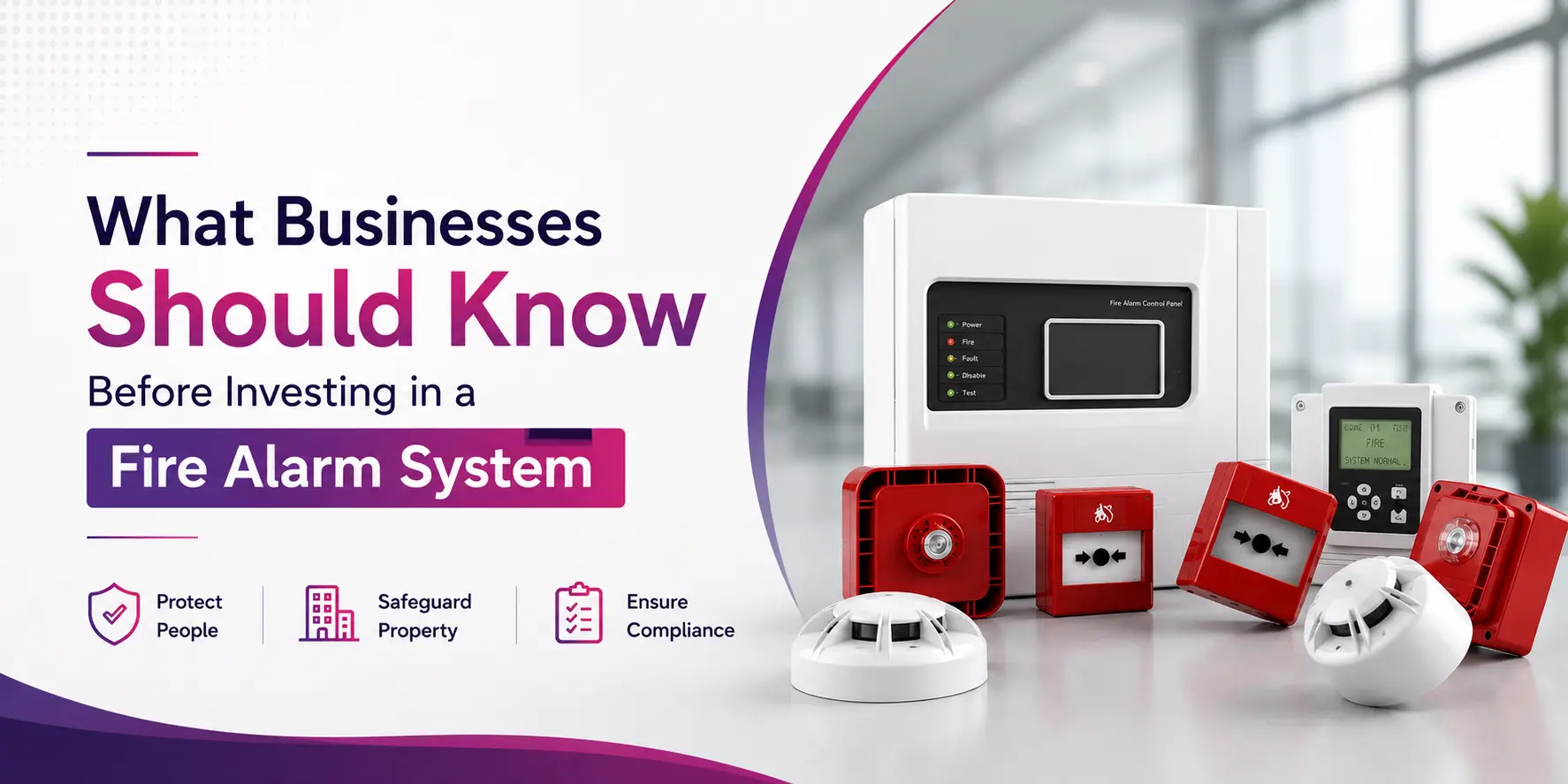
A fire alarm installation can include several components working together to detect and communicate potential fire incidents.
Common components include:
- Smoke detectors
- Heat detectors
- Gas leak detectors
- Beam detectors
- Aspiration detectors
- duct detectors
- LHS cables
- Input/output modules
- Manual call points
- Fire alarm control panels
- Audible alarm devices
- Visual alarm indicators
- Notification devices
- Batteries and power supplies
- Associated accessories
The exact combination depends on the building, application, system design, and applicable requirements.
Businesses should therefore avoid selecting individual products without considering how the complete system will operate together.
Conventional vs Addressable Fire Alarm Systems Explained
Businesses may come across different types of fire alarm systems when researching their options.
Conventional Fire Alarm Systems
A conventional system divides the building into zones. The system indicates the relevant zone on the control panel when a detector or manual call point is triggered, helping personnel identify where the alert originated.
This type of arrangement can be suitable for certain smaller or less complex premises where detailed device-level identification is not essential.
Addressable Fire Alarm Systems
An addressable system assigns individual identification to connected devices. This allows the control panel to provide more detailed information about the location of an activated device.
For larger or more complex buildings, this level of information can make incident identification and response more efficient.
The right choice depends on the building’s size, complexity, risk profile, operational requirements, and budget.
Why Product Quality Matters
Fire alarm equipment is a safety-critical investment. Businesses should therefore pay close attention to the quality, reliability, compatibility, and availability of the products being considered.
When evaluating a Fire Alarm System Supplier, businesses should ask about:
- Product specifications
- Manufacturer information
- System compatibility
- Warranty provisions
- Availability of replacement components
- Technical support
- Installation expertise
- Maintenance requirements
Choosing products purely because they have a lower initial price can create problems later if equipment is unreliable, difficult to maintain, or unsuitable for the application.
A dependable Fire Alarm Supplier should focus on recommending a complete system that meets the property’s requirements rather than simply supplying individual devices.
Why Professional Installation Is Important
Even high-quality fire alarm equipment can fail to deliver the expected performance if it is poorly designed or incorrectly installed.
Professional installation involves more than mounting detectors and connecting cables. The system needs to be planned according to the building layout, connected correctly, configured appropriately, and tested before being placed into operation.
Experienced professionals can also identify practical issues that may not be obvious during a basic product selection process.
Businesses should therefore consider the supplier’s technical capabilities before purchasing equipment.
Why Regular Testing and Maintenance Matter
Installing a fire alarm system is not the final step. Regular inspection, testing, and maintenance are essential for keeping the system operational.
Over time, components can become damaged, batteries can lose capacity, and environmental conditions can affect detector performance. Routine checks can help identify these issues before they compromise system reliability.
Businesses should establish a maintenance programme that considers:
- Detector condition
- Alarm functionality
- Control panel operation
- Battery performance
- Manual call points
- Notification devices
- Wiring and connections
- System fault indicators
Maintenance requirements may vary depending on the system and application, so businesses should follow the manufacturer’s recommendations and applicable requirements.
When Should a Business Consider Upgrading Its Fire Alarm System?
An existing system may no longer be suitable when a business expands, changes its building layout, adds new equipment, or changes how particular areas are used.
Signs that an upgrade may need to be considered include:
- Frequent system faults
- Outdated or unsupported equipment
- Expansion of the premises
- Changes in occupancy
- Additional fire risks
- Difficulty obtaining replacement components
- Poor integration with other building systems
A professional assessment can help determine whether the existing installation can be upgraded or whether a new system would be more appropriate.
How Can a Fire Alarm Distributor Help Businesses?
Working with an experienced Fire Alarm Distributor in Ahmedabad can simplify the process of selecting and implementing a suitable system.
A knowledgeable distributor can assist with:
- Understanding the property’s requirements
- Recommending appropriate products
- Planning the overall system
- Supplying compatible components
- Coordinating installation
- Testing/commissioning support
- Providing technical support
- Repair or replace faulty devices when required
Businesses should evaluate the distributor’s product knowledge, technical experience, support capabilities, and ability to provide a complete solution.
Searching for Fire Alarm Suppliers Near Me or Fire Alarm Dealers Near Me may provide several local options, but businesses should compare suppliers based on expertise and service quality rather than location alone.
Why Choose ADI Solutions?
ADI Solutions provides comprehensive security and safety solutions for businesses with different operational requirements. Its fire safety offering is supported by technical expertise, product knowledge, and a focus on dependable system implementation.
The team can assist businesses with understanding their requirements, selecting appropriate products, implementing the system, and maintaining it over time.
For organisations looking for a reliable Fire Alarm System Supplier, having access to technical guidance and ongoing support can make a significant difference to the long-term performance of the installation.
Whether the requirement involves a commercial office, industrial facility, warehouse, healthcare environment, educational institution, or another type of property, the system should be planned around the specific risks and characteristics of the premises.
Conclusion
Investing in a Fire Alarm System requires careful consideration of the property’s size, layout, fire risks, detection requirements, product quality, installation, and ongoing maintenance. Businesses should avoid treating fire alarm equipment as a simple purchase and instead consider the complete lifecycle of the system.
Working with an experienced Fire Alarm Distributor in Ahmedabad can help businesses evaluate their requirements, select compatible products, and establish a reliable fire detection and notification infrastructure.
ADI Solutions provides professional security and safety solutions designed around the needs of different business environments. If your organisation is planning a new fire alarm installation or reviewing an existing system, professional guidance can help you make a more informed decision.
Frequently Asked Questions
1. Why does a business need a Fire Alarm System?
A Fire Alarm System provides an early warning of potential fire incidents, helping occupants and responsible personnel respond promptly and follow appropriate emergency procedures.
2. How should a business choose a Fire Alarm Supplier?
Businesses should evaluate product quality, technical expertise, installation capabilities, system compatibility, warranty provisions, maintenance services, and after-sales support before selecting a Fire Alarm Supplier.
3. Should businesses choose conventional or addressable fire alarms?
The appropriate system depends on factors such as building size, layout, complexity, fire risks, and operational requirements. A professional assessment can help determine which configuration is suitable.
4. Why is fire alarm maintenance important?
Regular maintenance helps identify faults, damaged components, battery issues, and other problems that could affect system performance. It supports the continued reliability of the installation.
5. How can businesses find Fire Alarm Dealers Near Me?
Businesses can search for Fire Alarm Dealers Near Me, then compare their technical expertise, product range, installation capabilities, maintenance support, and experience with similar projects before making a decision.